USA TODAY CO. Crafting a Voice for 200+ Local News Brands
The Challenge
USA TODAY CO owns more than 200 local news publications. Each serves a different community and covers everything from breaking news and investigative journalism to food, sports, entertainment, and local culture.
That creates a complicated tonal challenge: How do we maintain a voice that feels consistent and recognizable across hundreds of publications while allowing it to appropriately adapt to radically different subjects and emotional moments?
As Director of Brand Marketing, I was accountable for ensuring that our marketing comms felt appropriate, consistent, and on-brand across that entire ecosystem.
The answer couldn't be a single, rigid tone.
The Opportunity: Show, Don't Tell
Most tone-of-voice systems rely on characteristics and rules to describe a voice. While those guidelines are useful, and have their place, they’re also inherently abstract and can be difficult to apply consistently.
That's especially true when the voice needs to flex between a restaurant opening, a devastating weather event, and a hard-hitting investigative report.
I saw an opportunity to make the system more intuitive.
Instead of describing how the brand should sound, I wanted to help writers and stakeholders imagine the person speaking.
Imagining the speaker gives a more immediate sense of rhythm, vocabulary, emotional presence, and attitude. You don't have to memorize a long list of adjectives when you can picture the person behind the words.
With hundreds of publications, countless stakeholders, and an enormous range of content, the system also needed to be memorable enough to use without constantly referring back to a lengthy brand document.
The Approach
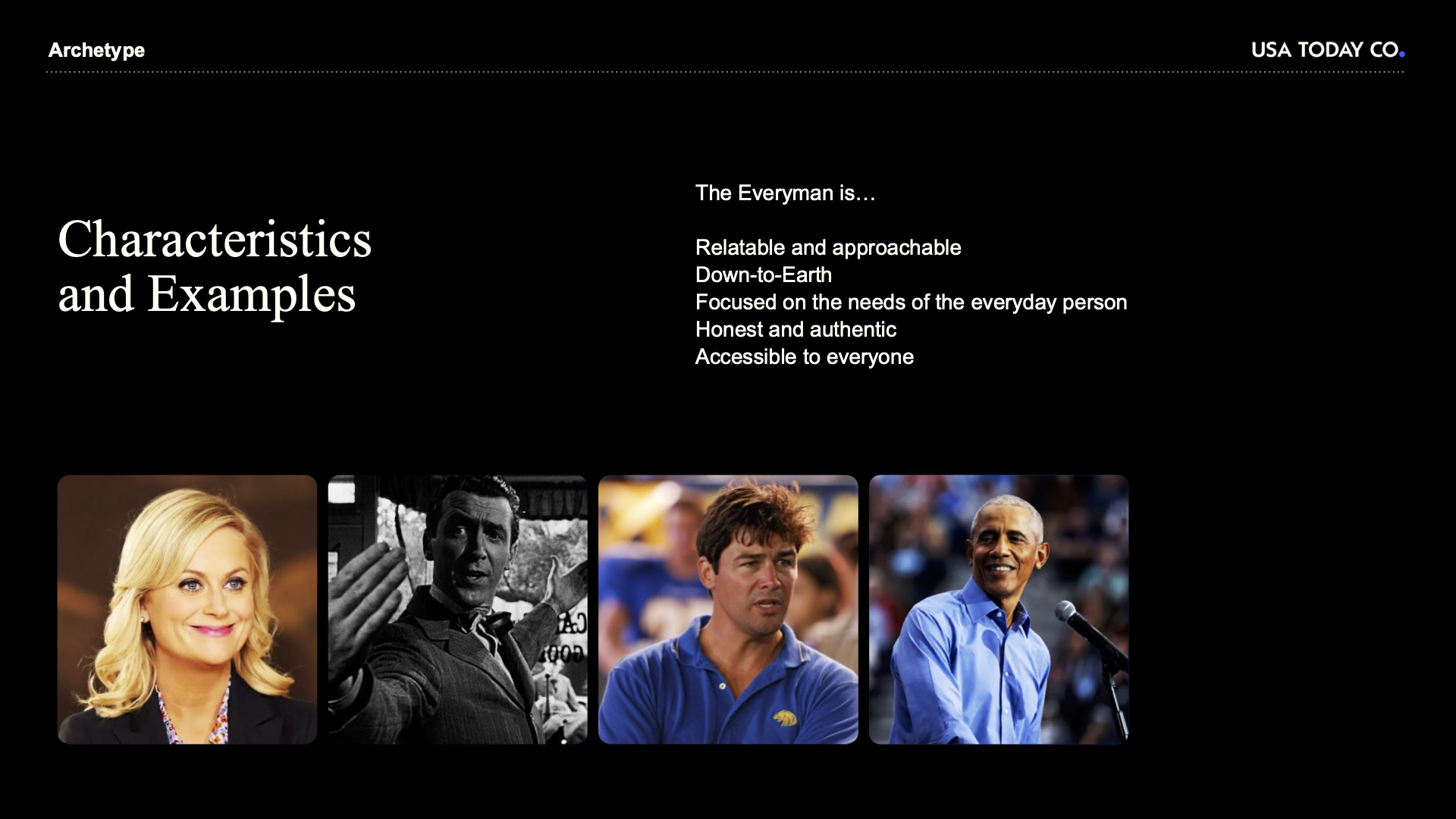
I designed a tone-of-voice system built around four recognizable personalities, each representing a different emotional mode our local brands need to access.
The goal wasn't to imitate these people, but to use them as creative shorthand that helps writers quickly understand the spirit behind the voice.
The personalities allowed the tone to flex based on the emotional context of the content. Community celebrations could feel enthusiastic. Breaking news could feel emotionally present. Investigative journalism could communicate with calm conviction.
Different expressions of our voice, all rooted in the same underlying brand.
The Voice Framework
Four personalities defined how we approached writing for different emotional moments and content types.
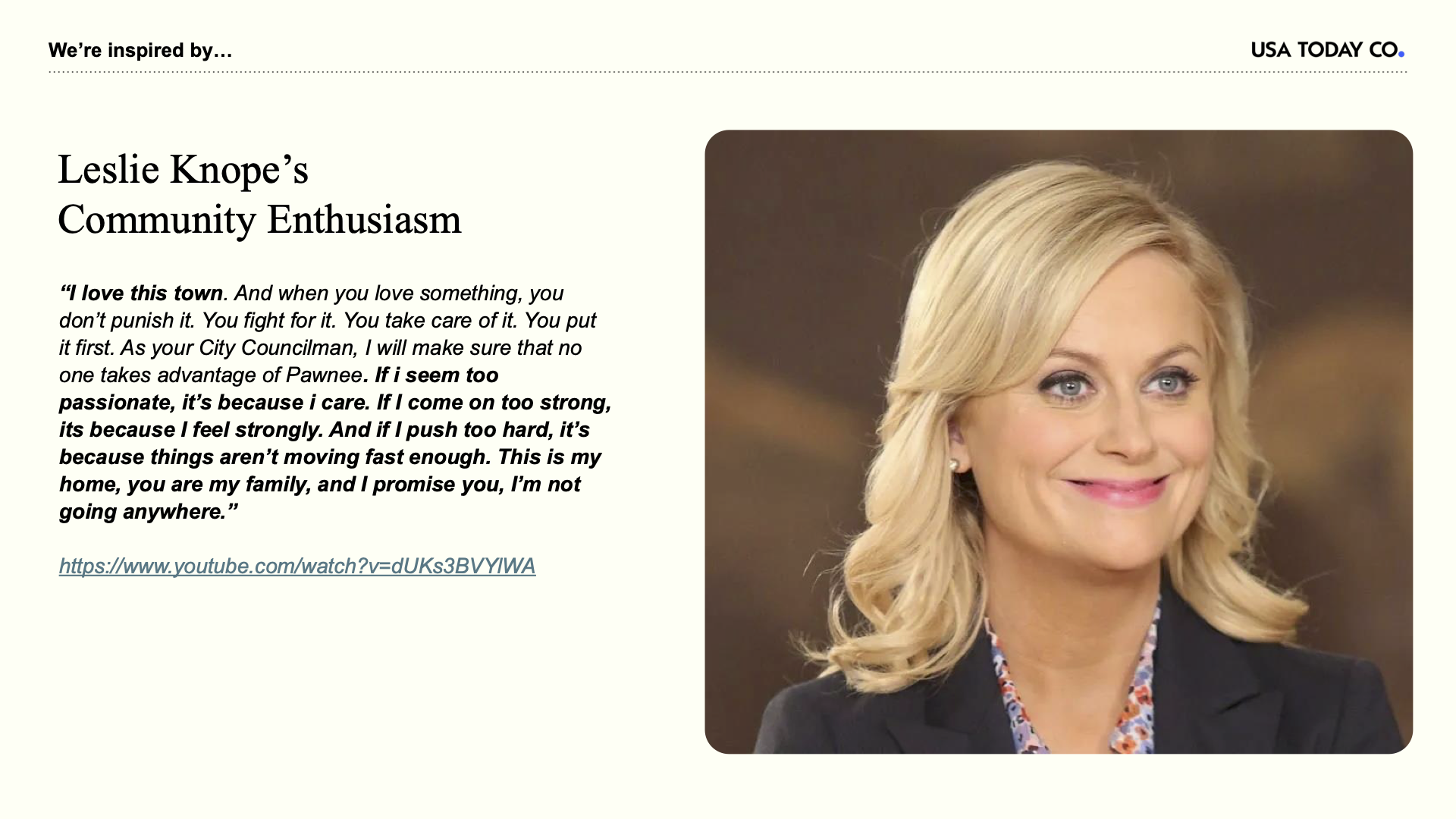
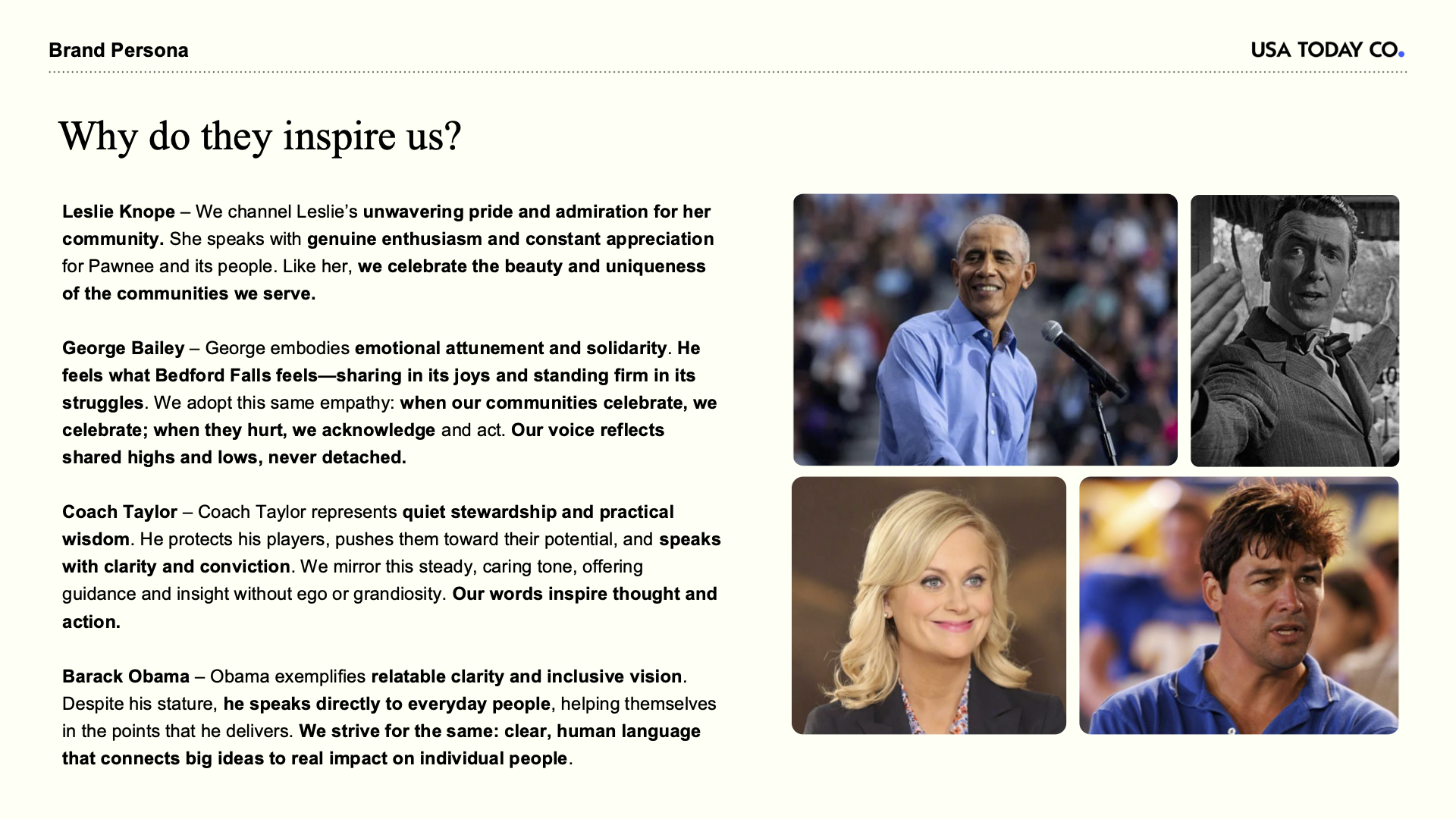
Leslie Knope’s Community Enthusiasm and Hometown Pride
When promoting Sports, Entertainment, or food and dining content, we channel Leslie’s unwavering pride and admiration for her community.
She speaks with genuine enthusiasm and constant appreciation for Pawnee and its people. Like her, we celebrate the beauty and uniqueness of the communities we serve.
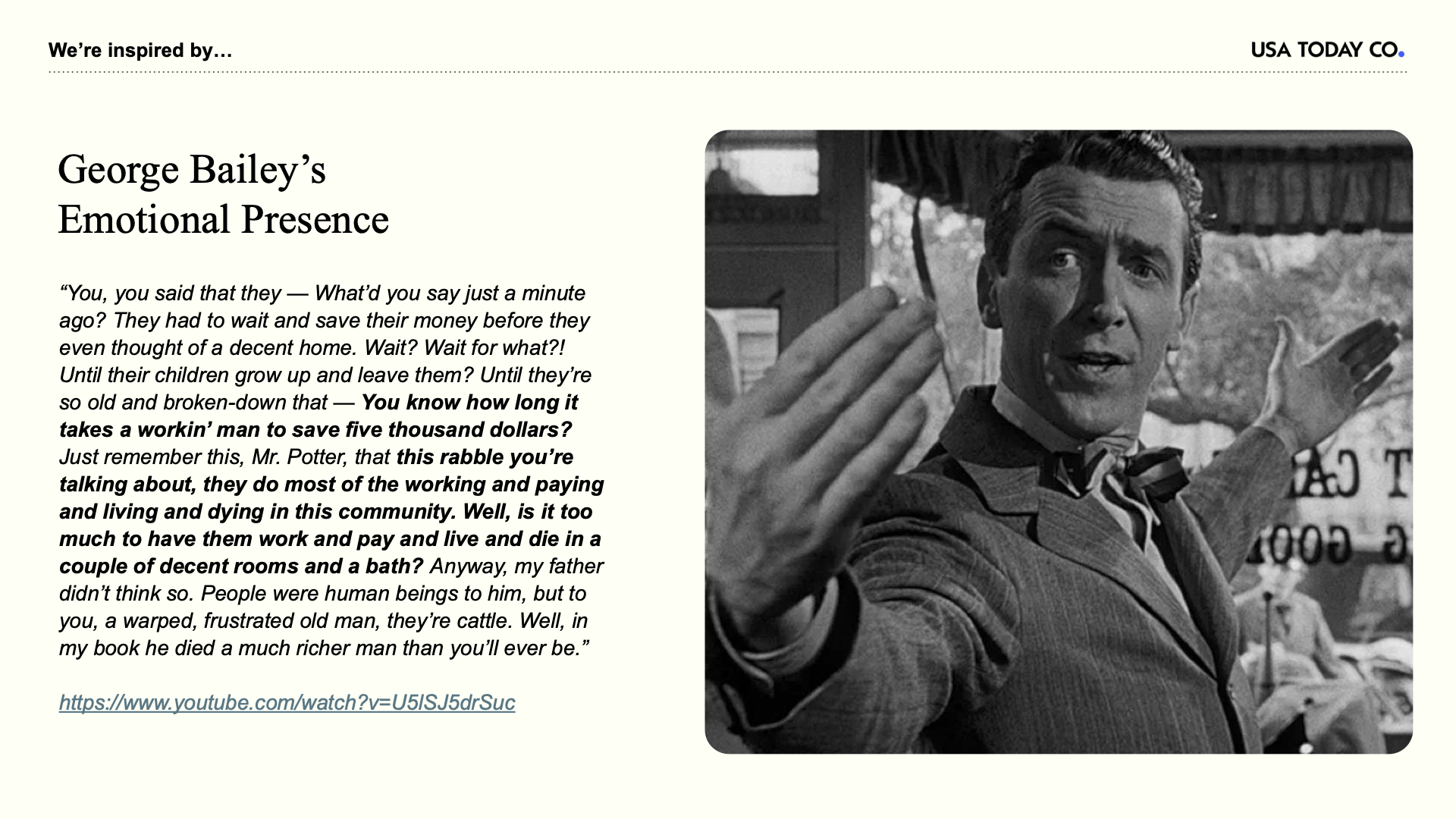
George Bailey’s Emotional Presence
When promoting Breaking News, Weather Events, or Industry News, we mirror George’s emotional presence.
He embodies emotional attunement and solidarity. He feels what Bedford Falls feels—sharing in its joys and standing firm in its struggles. We adopt this same empathy: when our communities celebrate, we celebrate; when they hurt, we acknowledge and act. Our voice reflects shared highs and lows, never detached.
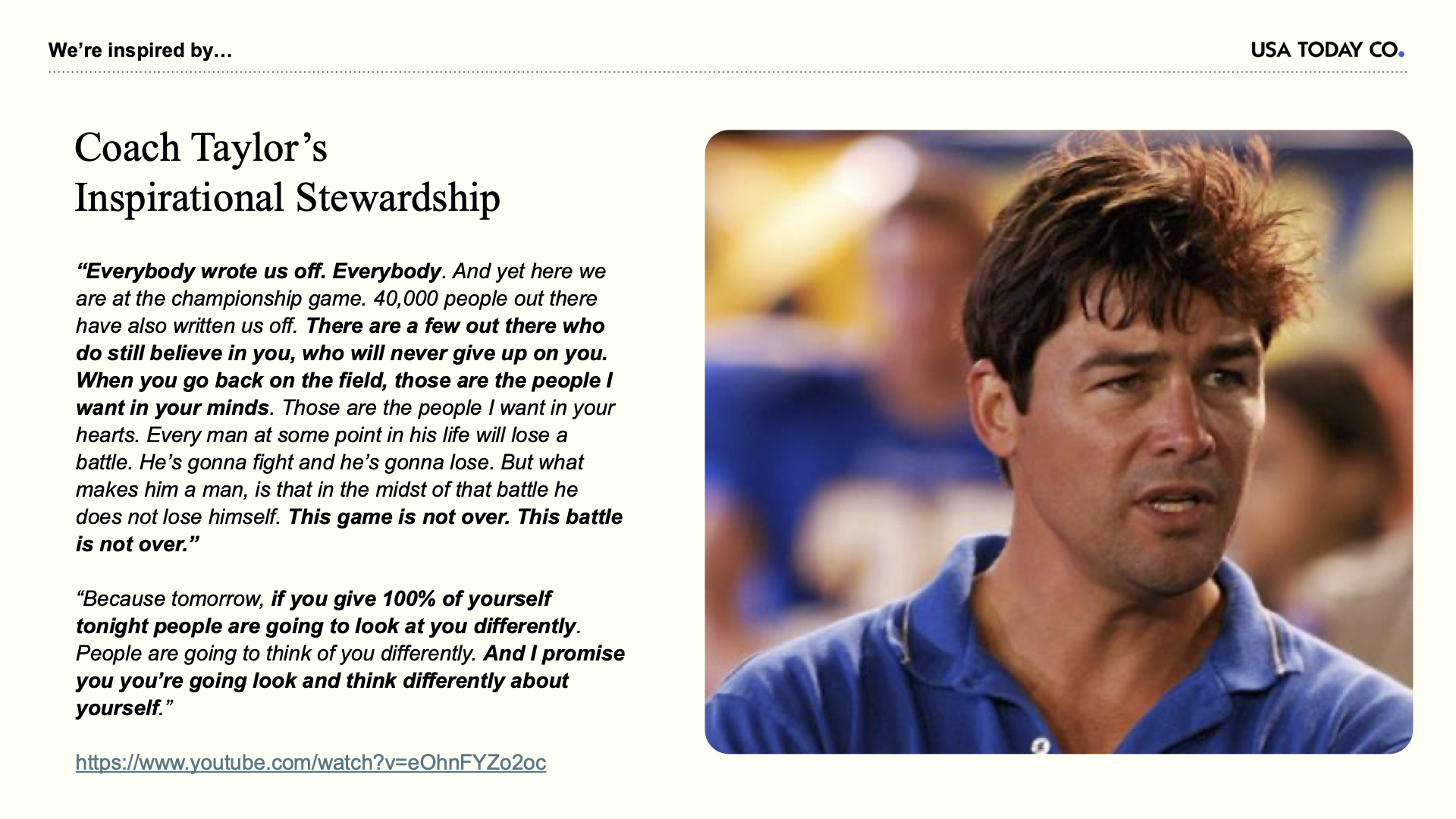
Coach Taylor’s Inspirational Stewardship
When promoting Investigative Journalism, or our dedicated service to our community, we reflect Coach Taylor’s Inspirational Stewardship.
Coach Taylor represents quiet stewardship and practical wisdom. He protects his players, pushes them toward their potential, and speaks with clarity and conviction. We mirror this steady, caring tone, offering guidance and insight without ego or grandiosity. Our words inspire thought and action.
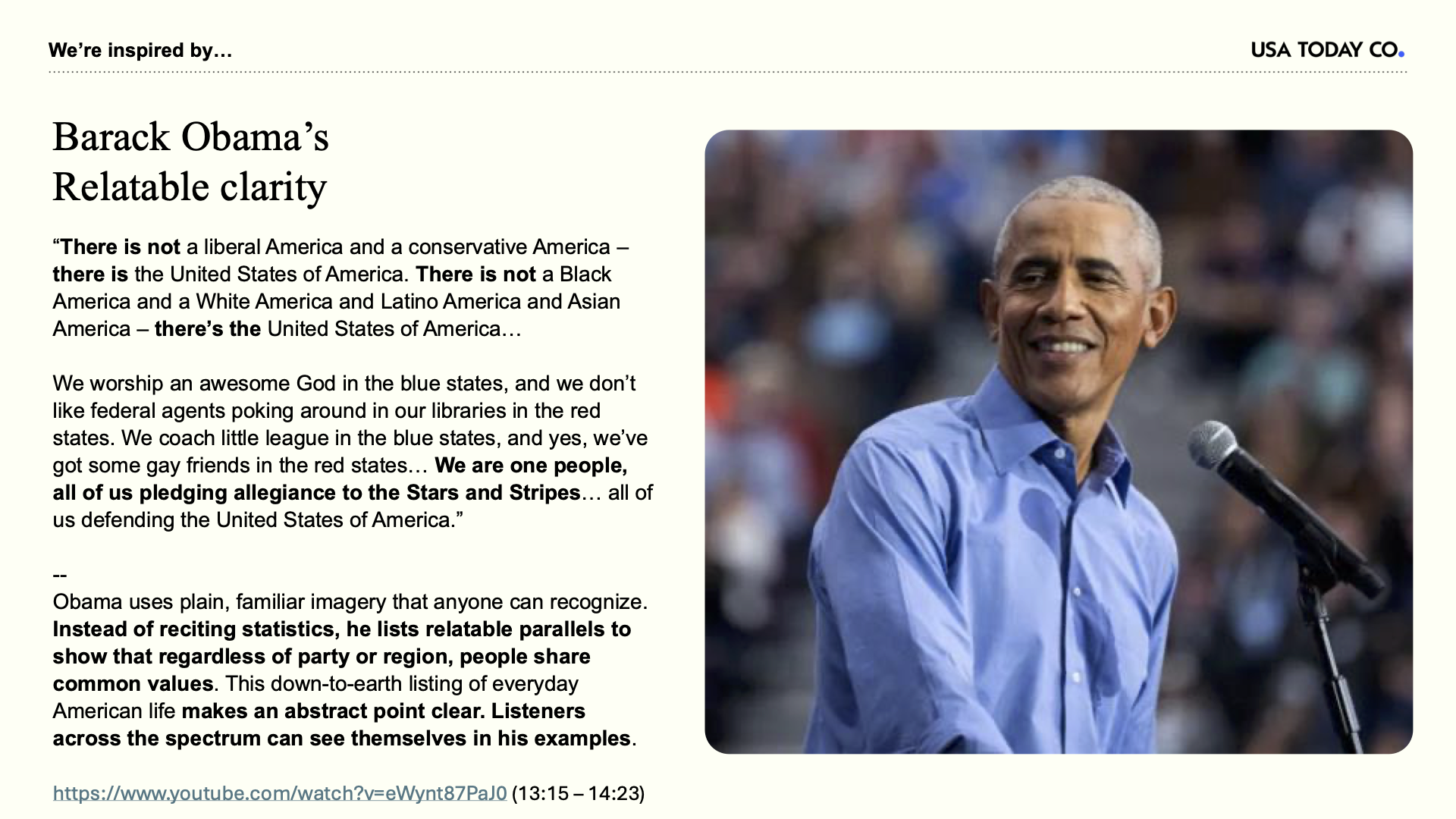
Barack Obama’s Relatable Clarity
When Political or Financial coverage, we employ Barack Obama’s relatable clarity.
Obama exemplifies clear, convicting communication and inclusive vision. Despite his stature, he speaks directly to everyday people, helping themselves in the points that he delivers. We strive for the same: clear, human language that connects big ideas to real impact on individual people.
From Inspiration to Application
A creative device is only useful if people can actually put it into practice.
The personalities made the system easier to understand and remember. From there, we translated those inspirations into four practical principles that could guide everyday writing decisions.
We are connectors of community (Leslie Knope)
Our role isn’t just reporting news. It’s helping to bring people closer to their hometown and to their neighbors. The messaging we write should feel like an invitation to connect, celebrate, and care.
What This Means for How We Speak
Use inclusive language that speaks to unity: “we,” “our.” “home”, “hometown”
Where possible (and legal), mention local traditions, landmarks, personalities, and shared experiences.
We focus on others, not on ourselves. We speak directly to our audience, addressing their needs and wants.
Avoid distant or institutional tone—sound like a trusted neighbor.
We are emotionally present (George Bailey)
We mirror the heartbeat of the community. When they cheer, we cheer. When they hurt, we acknowledge and act. Our tone reflects empathy, not detachment.
What This Means for How We Speak:
We match the emotional temperature of the moment from joy, to concern, to pride.
We don’t just feel the emotions, we also sense the questions, concerns, excitements, etc of our neighbors. We address those feelings and thoughts in our messaging.
We avoid sensationalism or cold neutrality; be human and sincere.
We are Quiet Stewards (Coach Taylor)
We protect and serve quietly, with care and conviction. Our words should reassure and guide, not boast. Stewardship is shown through clarity and action.
What This Means for How We Speak
Speak with calm authority: “Here’s what we know,” “Here’s what we’re doing.”, “We’re here”.
Emphasize our own responsibility and trustworthiness without self-congratulation.
Avoid self-important language. Let care show through tone and transparency.
We mention the reader more than the publication.
We are Champions of Clarity (Barack Obama)
We prioritize understanding over cleverness. Our copy should be crisp, direct, and easy to grasp, never cryptic or cluttered.
What This Means for How We Speak
Lead with the point. Don’t bury the lede.
Don’t ask the reader to read through a joke or clever wordplay to get to the message.
Cleverness and wordplay can be used as a vehicle for the message, but never as a preamble to it.
Use short, strong sentences and plain language.’
Bringing It All Together
The four personalities aren’t intended to create four separate voices, just different expressions of the same underlying idea.
Together, they form a single overarching persona: The Community Champion.
This became the system's anchor point, a character that writers and stakeholders can imagine whenever they need to make a judgment call about how the brand should sound.
Our Brand Persona: The Community Champion
Before the first float drifts by at the Homecoming parade, The Community Champion is already there—chatting with neighbors and soaking in the hum of hometown pride. They’re not just present; they’re part of the fabric of the place. They know the stories behind every street corner and landmark, and they speak about them with genuine admiration, never as an outsider looking in.
You’ll find them at the diner sharing a laugh, listening intently at the town hall, or celebrating the opening of a local restaurant. They don’t just report what happens; they feel it. When the community celebrates, they celebrate. When the community struggles, they help people understand what’s happening and what can be done. Their empathy is quiet but powerful, and their words carry care without ever sounding self-important.
They speak with clarity and conviction, like a trusted neighbor offering practical wisdom that makes complex issues feel personal and solvable. Their tone is warm, human, and inclusive—never cryptic, never clever for its own sake. They invite people in, encourage participation, and make everyone feel like they belong to something bigger than themselves.
The Community Champion is enthusiastic without being overbearing, protective without being grandiose, and deeply committed to the people they serve. They are the steady voice that says, “We’re in this together. Here’s what matters. Here’s what’s next.” Always present, always connecting, always championing the community.
Role: Director of Brand Marketing, Creative Strategist